
Free template · OSHA 29 CFR 1910.38
Free emergency action plan template
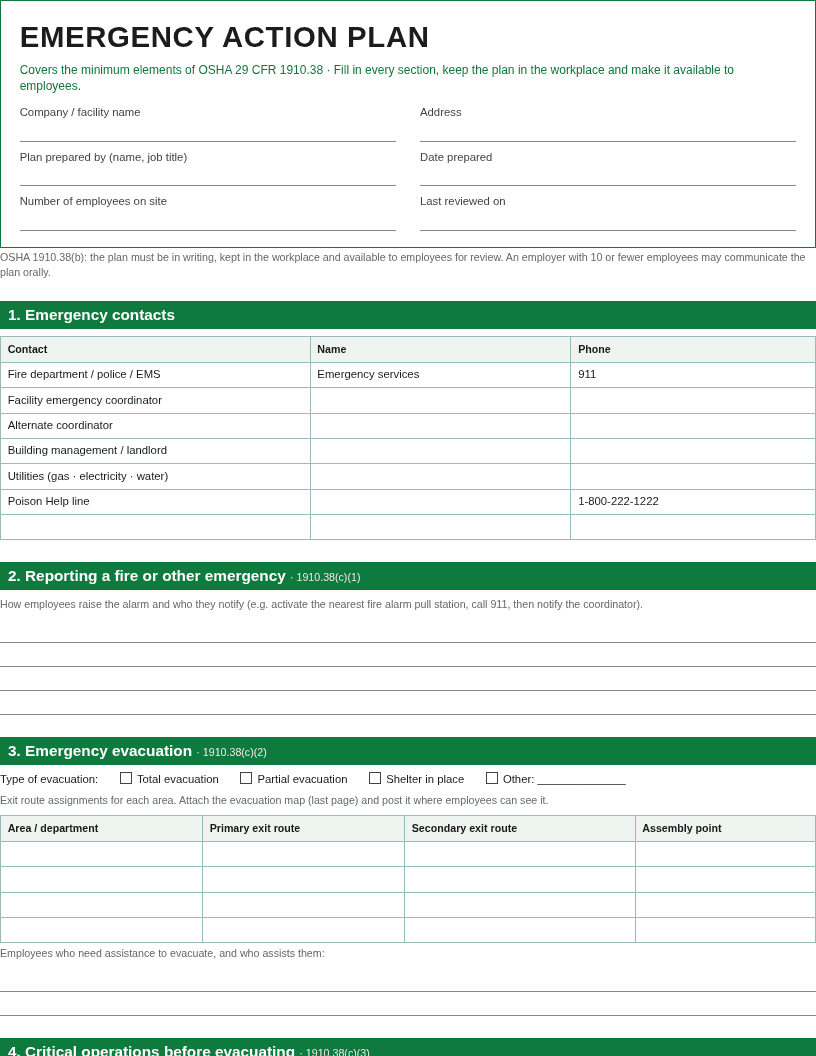
A fill-in emergency action plan that follows every minimum element OSHA 1910.38 requires, plus a blank evacuation map. US Letter, PDF and Word, free, no sign-up.
What is an emergency action plan?
OSHA’s rule is short: “An employer must have an emergency action plan whenever an OSHA standard in this part requires one” (29 CFR 1910.38(a)). In practice the fire-related standards make it a requirement for many workplaces — for example, an employer who requires employees to evacuate rather than fight a fire with portable extinguishers needs an EAP that meets 1910.38.
The plan must be in writing, kept in the workplace and available to employees. Employers with 10 or fewer employees may communicate it orally.
What OSHA requires in an emergency action plan
Reporting a fire or other emergency
Emergency evacuation
Critical operations
Accounting for employees
Rescue and medical duties
Plan contacts
- Employee alarm system — a distinctive signal for each purpose, compliant with 1910.165 (1910.38(d)).
- Training — designate and train employees to assist in a safe and orderly evacuation (1910.38(e)).
- Review — go over the plan with each employee when it is developed, when their duties change and when the plan changes (1910.38(f)).
- Written and available — kept in the workplace for employees to review; oral plans are allowed with 10 or fewer employees (1910.38(b)).
What’s inside the template
- Cover page: facility, plan owner, preparation and review dates
- Emergency contacts, with 911 and the Poison Help line pre-filled
- Reporting procedures and evacuation type (total, partial, shelter in place)
- Exit route assignments by area, with primary and secondary routes and assembly points
- Critical operations shutdown before evacuating
- Headcount procedure for employees, visitors and contractors
- Rescue and medical duties (first aid, CPR, AED)
- Plan contacts, alarm signals, training and drill log, review log
- Evacuation map page with a scaled grid and a symbol legend
How to fill in your emergency action plan
- 1
Walk the facility
Note every exit, exit route, alarm pull station, extinguisher, first aid kit and AED, and the areas with critical equipment. - 2
Assign people
Name the emergency coordinator, the evacuation wardens, the employees who shut down critical operations and those with rescue or medical duties. - 3
Write the procedures
Fill in how to report an emergency, the exit route for each area, the assembly points and the headcount procedure. - 4
Draw the evacuation map
Sketch the floor plan on the map page, mark “You are here”, the exit routes and the safety equipment, and post it in each area. - 5
Train, drill and review
Review the plan with every employee, run a drill, log it, and update the plan whenever the building or the team changes.
How an emergency action plan benefits your workplace
Faster, calmer evacuations
Nobody left behind
Safer shutdowns
Ready for inspections
Turn the map page into a professional evacuation plan
Emergency action plan vs. emergency response plan
Emergency action plan template: FAQ
What is an emergency action plan?
An emergency action plan (EAP) is a written document that sets out how employees report an emergency, evacuate, account for everyone and who does what. Under OSHA 29 CFR 1910.38, an employer must have one whenever an OSHA standard requires it, and the plan must cover at least the six minimum elements listed in paragraph (c).
What is the purpose of an emergency action plan?
Its purpose is to organize employer and employee actions during a workplace emergency, so that everyone knows how to raise the alarm, which exit route to take, where to gather and who to contact. A clear plan reduces confusion and injuries during an evacuation.
Does every business need a written emergency action plan?
OSHA requires an EAP whenever an OSHA standard requires one. The plan must be in writing, kept in the workplace and available to employees, but an employer with 10 or fewer employees may communicate the plan orally (1910.38(b)).
How often should the emergency action plan be reviewed with employees?
OSHA 1910.38(f) requires reviewing the plan with each covered employee when the plan is developed or the employee is first assigned to a job, when the employee’s responsibilities under the plan change, and when the plan is changed.
Is this template approved by OSHA?
OSHA does not approve templates. This template is structured around the minimum elements of 29 CFR 1910.38 and leaves room for your own procedures; you remain responsible for adapting it to your facility and to the standards that apply to your workplace.
What is the difference between an emergency action plan and an emergency response plan?
An emergency action plan covers what employees do to stay safe: reporting, evacuating and accounting for everyone. An emergency response plan usually goes further and covers how the organization responds to and recovers from an incident. The EAP is the OSHA-required core that the response plan builds on.
Your plan is ready.
Now make the map.
No card required · Export from €9.99